Showing posts with label history. Show all posts
Showing posts with label history. Show all posts
Monday, 25 April 2016
St Luke's

St Luke’s is a converted church turned music and arts venue. The former
disused 19th century church on Bain Square in Calton is thought to
be one of the oldest churches in Glasgow. Originally built in 1837, the church
has been restored and modernised to high standards. One wall of the church is
even covered in a mural of Saint Luke with a record in hand and headphones
around his neck. However, many of the original features have been left intact,
including the beautiful stained glass windows.
The restaurant area – the Winged Ox – hosts an American
diner-style menu, with ribs, steaks, burgers, sandwiches and pizzas making up
most of the menu.
The venue hosts many events of all different types from
comedy nights to theatre and music.
If you are interested in seeing
the transformation of this beautiful building into the thriving, modern venue
it has become, please click here to watch a video of the transformation.
Glasgow Necropolis

The Necropolis is a Victorian cemetery to the East of
Glasgow Cathedral. In 1651 the area was known as Fir Park due to the grounds
being covered in fir trees. In 1831 city merchants decided that the park would
be better suited to being used as Glasgow’s version of the famous Pere Lachaise
Cemetery in Paris. Over 50,000 people were buried at the Necropolis with 3500
tombs of varying size and stature.
Many wealthy merchants and noble people were buried here,
and tombs were built to represent each person’s importance and wealth. Many
major architects and sculptors of the time created tombs for the dead,
including Charles Rennie Macintosh, Alexander ‘Greek’ Thomson and JT Rochead.
John Knox has the tallest and earliest monument; others are
not far behind in height. Undiscovered Scotland recommend viewing the mausoleum
of Major Archibald Douglas Monteath.
“This
is a highly ornate 30ft diameter structure modelled on the Church of St
Sepulchure in Cambridge. The level of detail is amazing, with every window-arch
on the lower level bearing a different pattern. Perhaps the most imposing
monument in terms of its combined location, bulk, height and detail is the 35ft
high William Gavin Monument shown in the header image. Others are much more
modest in scale, like the memorial erected by public subscription to William Miller, author of the nursery rhyme "Wee
Willie Winkie".
Today the Necropolis is a great place to visit, with spectacular
views over the city of Glasgow from the top. Once within the Necropolis the
winding paths can seem confusing. However, there are walking guides on sale in
the nearby St Mungo Museum of Religious Life and Art, and walking tours are
also available. However, if you just keep following the path uphill you soon
find yourself at the top of the Necropolis which hosts the largest tombs.
For more information about the Necropolis visit their
website http://www.glasgownecropolis.org/
or visit the site itself, just off Castle Street, Glasgow.
Tuesday, 5 April 2016
Glasgow Cathedral
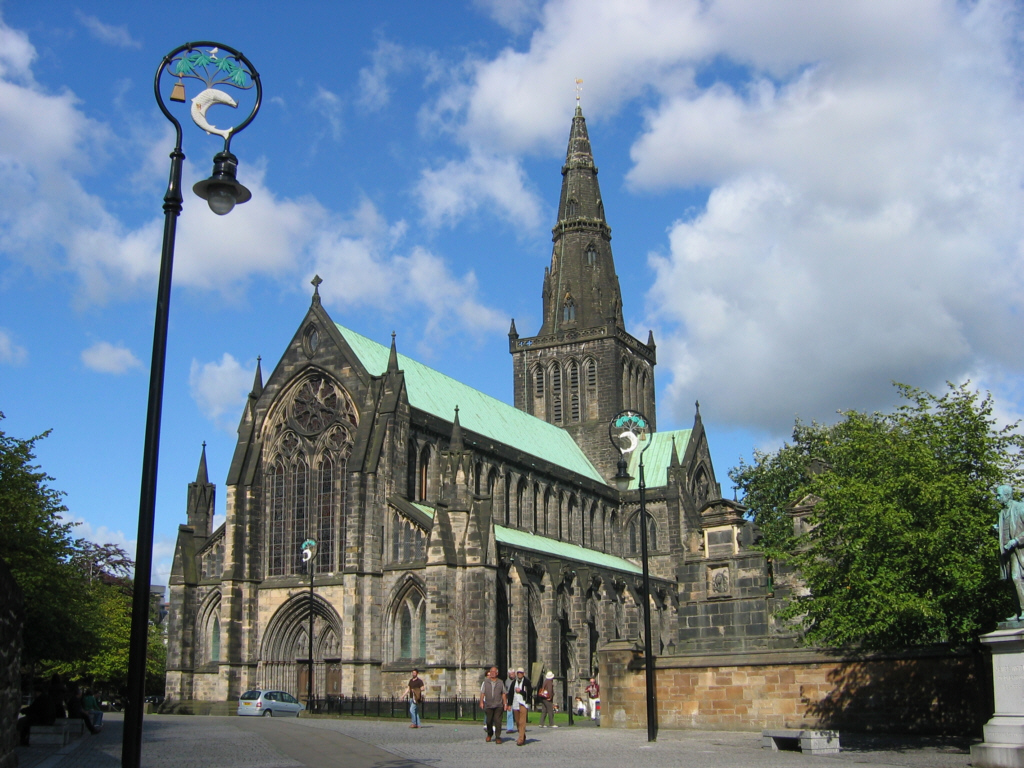
The Glasgow Cathedral is one of Scotland’s
most magnificent medieval buildings and one of the only ones to survive the
1560 Protestant Reformation. The Cathedral was built on where St Mungo, the
first bishop of Strathclyde, was supposed to have been buried in AD 612. The
tomb of St Mungo is held in the Crypt within the Cathedral.
The present building was built in 1197
and since then it has never been unroofed and has carried on being used as a
church for over 800 years.
The dark, imposing
interior is a shining example of Gothic architecture. The cathedral is
decorated with seven pairs of figures who represent the seven deadly sins.
There are four stained-glass panels on the east window which depict the
Apostles. The cathedral boasts one of the best post-war collections of stained
glass windows in Britain with the Apostles window being amongst the most
impressive.
The most interesting
part of the cathedral is the lower church, which is reached by a stairway which
dates back to the 12th century with steps being slightly worn from
years of use. A forest of pillars creates a dark spooky atmosphere around the
tomb of St Mungo.
Other connections
with the cathedral include one of Scotland’s most famous authors, Sir Walter
Scott. He refers to the Cathedral in his novel Rob Roy. Another must see part
of the cathedral is the breath-taking white ceiling in the Blackadder Aisle
which was built by Archbishop Blackadder in 1500.
Even if you aren't hugely
into religion or history, the Glasgow Cathedral is worth a visit just for the
incredible architecture. The cathedral is regarded as one of the top 25 things
to do in Glasgow according to TripAdvisor. It is free to visit as is the museum
next door, the St Mungo Museum of Religious Life and Art. It is usually open
daily, with limited hours on Sundays as it is a functioning church.